He had everything: a loyal wife, five children who admired him, and a house that looked like a palace, but one night he threw them out like trash. Years later, he returned with his head bowed, and not even his children remembered him.
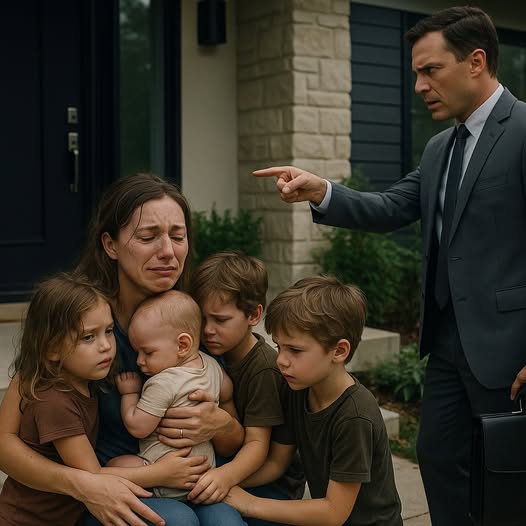
This is the story of a man who lost everything through pride and a woman who, with dignity, rebuilt her world from scratch. I never want to see you in this house again, not you or any of your blessed children. Thus thundered the voice of Don Ernesto Villarreal, echoing through the walls of a mansion in the Providencia neighborhood of Guadalajara. It was a hot, windless night, but in that marble room with velvet curtains, the air could be cut with a knife.
Magdalena remained silent, her heart sinking, five pairs of small eyes staring at her fearfully. “Ernesto, please, they’re your children,” she whispered, but he wasn’t listening anymore. He only saw them as a nuisance and her as a dead burden. With a glass of wine in her hand and her face hardened with contempt, she pointed toward the front door.
Leave now before I regret not doing it sooner. Camila, 12, was trembling. Luisito hugged Mateo tightly. Ana Lucía clung to her mother’s skirt, and Tomás, the youngest, didn’t understand anything. He just cried. Magdalena took a breath, not to respond, but to keep from collapsing. She lifted her chin, took Tomás in her arms, and with her other hand pulled Camila toward the door.

On the other side, the city continued as if nothing had happened, as if a family weren’t being torn apart from within. Before continuing, I offer you a sincere invitation. If you’re already feeling something in your heart, subscribe to the channel, activate the bell, and leave your like, because this story is based on events that happen more often than we think, and it will touch your heart.
And if you’ve ever seen someone pay dearly for an injustice, write the word “justice” in the comments. Now, we continue. They walked for more than an hour through the streets of downtown, carrying a backpack with some clothes and important papers. No one offered help, no one asked, no one cared. Magdalena didn’t know where to go. Her mother’s house was abandoned. The friends she had had left when Ernesto became rich. No one was left.
“Are we going to sleep on the street, Mom?” Camila asked. Magdalena looked at her, trying to smile. “Of course not, my love. Let’s go somewhere quiet.” She was lying; she didn’t know where to go. Until, in the midst of despair, she remembered a name: Damián López. An old friend, an impossible love from the past, someone who had never hurt her. They arrived at a simple street in Tlaquepaque. The houses were modest.
The lights dimmed in front of a rusty iron gate. Magdalena stopped. She knocked. She knocked again. A hoarse voice answered from inside. “Who am I, Magdalena?” The door opened slowly. Damián, with his old paint-stained shirt and his surprised face, said nothing at first.
He only saw Magdalena and the five children behind her. “What happened to you?” he asked without judgment. She couldn’t answer. Tears flowed without permission. Camila squeezed his hand. Tomás was already asleep in her arm. Damián let them in without questions, without conditions. “My house is small, but it’s enough for those who need it,” he said.
He made a hot tea, pulled blankets from the back of the closet, and for the first time in years, Magdalena slept without screams, without threats, without fear. But that night was more than a refuge. It was the beginning of something Ernesto himself hadn’t imagined. A story of dignity, reconstruction, and justice. The street was empty.
The echo of their footsteps resonated on the cracked sidewalks of the main avenue, as Magdalena walked forward with the five children walking behind her as if they were a single broken body. Camila carried the backpack of clothes. Luisito carried Tomás, half asleep, in his arms. No one was crying anymore.
Their tears had dried their skin, like the earth that stops asking for water when it resigns itself to the drought. Magdalena didn’t say a word. Her face was hard, her lips chapped, and her gaze fixed straight ahead. She didn’t know where she was going, but she couldn’t stop. If she stopped, the children would understand that there was nothing left. “Mom,” Camila said in a hoarse voice. “We’ll come back someday.” Magdalena took a deep breath.
She tried to find something inside her other than fear, but found only silence. “No,” she replied. She merely raised her hand and stroked her daughter’s hair without looking at her. Camila understood. There was no turning back. Luisito, who was 10, looked around. He had never seen his mother walk with her shoulders so slumped. For the first time in his life, he thought that adults could break too.
“Where are we going to sleep, Mom?” he asked, his voice barely audible. Magdalena gritted her teeth. She wanted to tell them that everything would be okay, that it was temporary, that Ernesto would come around, but she couldn’t lie to them anymore. They had heard everything. They knew their father didn’t love them. Nothing more. They passed by a closed bakery.
The smell of stale dough wafted out from under the metal curtain. Tomás woke up in Luisito’s arms and began to cry. Magdalena picked him up and rocked him without saying anything, while six-year-old Mateo walked, clinging to his mother’s skirt. The night heat was beginning to subside. A light breeze stirred dust from the ground.
The sky was clear, but there were no stars, only darkness above them. In the distance, the lights of a poorer neighborhood began to shine. Magdalena recognized the streets of her childhood. Claque Paque. That’s where she had grown up. That’s where she had laughed for the last time before marrying Ernesto. She stopped in front of a small house with whitewashed walls and a rusty iron gate.
Her heart pounded in her throat, not from fear of being rejected, but from shame. She hadn’t seen Damián in over 15 years. He had been her friend, her almost-boyfriend, but she chose another path. She chose Ernesto, and now she stood there, barefoot, her soul shattered. She looked at the children. They were exhausted.
They couldn’t keep walking. She knocked on the door once, twice. Nothing. She knocked again. This time more loudly. “Who?” a male voice answered, hoarse, surprised, and suspicious. “It’s me, Magdalena.” Silence. Slow footsteps were heard on the other side. The lock turned. The door opened slowly, and there he was, Damián López, with the same calm look as always, although with more wrinkles and hands covered in wood dust. He was wearing old pants and a sleeveless shirt.
His eyes widened at the sight of her. Then he looked at the children and understood everything without needing a single word. “What happened?” he asked in a low voice. Magdalena couldn’t speak; she just lowered her gaze, held Tomás tighter to her chest, and tears began to fall. She didn’t scream, didn’t explain, just cried. Damián didn’t ask any more questions; he stepped aside.
“Come in,” Camila said. She was the first to enter. Luisito and Ana Lucía followed her. Mateo followed. Magdalena entered last, as if she still doubted whether she deserved such a gesture. The door closed behind them, but for the first time that night, it didn’t sound like punishment, it sounded like shelter. Inside the house, the air smelled of wood, old coffee, and peace.
Damián offered them water. Then he reached for some blankets he had stored in a cardboard box. Magdalena looked at him silently, not knowing how to express her gratitude. She felt like any word would shatter the warmth of the moment. “My house is small, but it’s enough for you,” he said as he laid out the blankets on the living room floor. Tomás fell asleep immediately.
Mateo hugged Ana Lucía, and Luisito stared at the ceiling with his eyes open. Camila, on the other hand, wasn’t sleeping. Sitting against the wall, she looked at Damián from the corner. She watched him as if trying to remember why her mother had once walked away from him. Magdalena sat next to her daughter and stroked her hair. “Thank you for staying strong today,” she whispered.
Camila didn’t respond, just rested her head on his shoulder. Damián turned off the living room light, but didn’t go to his bedroom. He sat in a wooden chair, as if he knew that tonight wasn’t for resting, but for being, for holding, even if it was in silence.
Outside, the city slept, but inside that small house, a new story had just begun. And what was about to unfold in that humble home carried a weight none of them could yet imagine. Dawn arrived soundlessly.
The early morning heat gave way to a warm breeze that entered through the half-open windows of Damián’s house. Outside, the first rays of sunlight illuminated the tin roofs and cracked facades of the neighboring houses. Inside, in the living room, the silence was thick, sacred. The five children were still asleep on the floor, wrapped in borrowed blankets. Magdalena, on the other hand, hadn’t slept a wink.
Sitting in a corner, her back against the wall, she watched them breathe. One by one, she listened to their small snores, the involuntary movements of their tired bodies. She felt empty, as if the previous night had drained her soul. Damián appeared with two clay cups in his hand. He offered one to Magdalena. She received it with a shy gesture.
Hot pot coffee with cinnamon. She recognized it by the aroma. “You didn’t sleep at all, did you?” he asked without reproach. “I couldn’t,” she replied. “All of this still seems unreal to me.” Damián sat down on a small wooden bench opposite her. “You’re safe here, Magdalena. You and the children. No one’s going to touch you.”
She nodded silently, but her gaze remained blank. She found it hard to accept reality. She had gone from a marble dining room to a cement floor, from a powerful husband to a shared blanket, but she didn’t complain. She felt that, even though it hurt, this transition brought something that had never been peaceful in the mansion. Several minutes passed without speaking. Only the sound of someone washing dishes next door broke the silence.
“Do you remember that time you wanted to go to Puebla?” Damián said suddenly with a nostalgic smile. “You said you wanted to learn baking.” Magdalena was surprised. It had been years since anyone had reminded her of her dreams. “I said it as a joke,” she replied. “It didn’t seem like it. You had that look. Like someone who wants something more.” She lowered her gaze.
That look had long since faded. One of the children stirred. It was Luisito, who woke up rubbing his eyes. The first thing he saw was Damián sitting there. He hesitated for a moment. He didn’t know whether to feel comfortable or embarrassed. Damián smiled at him. “Good morning, champ. Did you sleep well?” Luisito nodded slowly. Then he looked around.
He didn’t ask where they were. He understood, without fully understanding, that this place was temporary or perhaps the beginning of something new. “Is there any bread?” he asked softly. Damián got up without a word, went out to the patio, grabbed a paper bag he’d saved from the day before, and came back with sweet bread. Four pieces.
There wasn’t enough for everyone, but Magdalena cut each one in half. It was her way of showing them that even if it’s a little, sharing is always enough. “Here, my loves, eat slowly,” she said. Tomás woke up in Camila’s arms. He sat up in confusion, as if he were still expecting to see the red carpet in the playroom of the old house.
But when he noticed the peeling wall and the damp-stained ceiling, he realized they weren’t there. He hugged his sister quietly. Damián watched everything without intervening. He knew he couldn’t heal what had happened, but he could be present. Sometimes silence is more healing than any words. When everyone had finished eating, Damián showed them a small room in the back.
There was an old wardrobe, a cot, and a window overlooking the courtyard. We can move the wardrobe, bring another mattress. It’s not much, but you can use this room if you want more privacy. Magdalena looked at him gratefully. She wasn’t used to selfless generosity. Thank you, Damián. Really, thank you. He shook his head. You don’t have to thank me for anything.
Just don’t disappear again. She swallowed. This wasn’t the time to talk about the past, but the sentence left something stuck in her chest. Camila, who was listening from the doorway, took a step forward. “Did you know my mom before?” Damián approached slowly. “Yes, long before you were born.”
And why weren’t they together? Camila asked without malice, but with genuine curiosity. Magdalena answered before him, because life sometimes takes you down paths you don’t understand until it’s too late. Camila looked down. She was processing many things at once. That morning passed slowly, but with a calm neither of them had felt in years.
The children began to explore the house, touching old tools in Damián’s workshop, sitting in the yard and playing with stones as if they were toys. Meanwhile, Magdalena watched silently, her heart filled with fear, but also with a small spark of something she hadn’t felt in a long time, something resembling hope. But just when it seemed the day would close peacefully, a knock on the front gate interrupted the moment. Damián went outside to see.
A thin woman in a white uniform, holding a folder, looked at him firmly. “Mrs. Magdalena Rivas lives here.” “Yes,” Damián replied. Seriously. The woman held out the folder. “You must appear in civil court on Monday. There’s a lawsuit against you.”
Magdalena stepped out upon hearing her name, took the document, and opened it with trembling hands. Her face fell as she read the heading: Complaint for fraud, signature: Ernesto Villarreal. The peace hadn’t lasted long, and this time the blow wasn’t just emotional; it was legal, and it came directly from the man who had taken everything from her. Magdalena held the folder with trembling hands.
It wasn’t just a document; it was a stab in the back written in black ink. The words “Fraud Complaint” left no room for doubt, and the signature at the end, Ernesto Villarreal, confirmed that no matter how low the man had sunk, his cruelty remained intact. Damián said nothing; he looked at her with a frown, his fists clenched, and his jaw rigid.
She knew something like this could happen. She knew the kind of man Ernesto was, but she didn’t think he’d go that far. “What’s he saying?” Camila asked from the doorway, her eyes glued to her mother’s every move. Magdalena was slow to respond.
She closed the folder carefully, as if afraid the letters would spill out of the paper and hit her in the face. “Nothing, my love, it’s a grown-up thing,” she said, trying not to break down. Camila didn’t insist, but the tension was noticeable in her body. She walked over to her siblings and led them into the bedroom. Luisito followed her without a word. Ana Lucía, on the other hand, turned to look at her mother before entering, as if something inside her told her that the woman who had cared for her since birth was about to collapse.
Once inside the house, Magdalena sat down on a dining room chair. She stared at the closed folder. Her stomach felt queasy and her chest tight. She couldn’t understand how Ernesto could continue to hurt her after leaving her on the street. Losing her home wasn’t enough punishment.
“Your clothes, your dignity, I’m going to talk to a lawyer,” Damián said, breaking the silence. “We can’t leave this like this, and how are we going to pay for it?” she replied, raising her voice for the first time, then correcting herself. “Sorry, it’s not with you.” Damián sat down in front of her, took her hand firmly, but without invading it. “Let me help you. I don’t want you to face this alone.” She nodded with a slight movement. Pride no longer had a place in her life.
She had learned the hard way that accepting help wasn’t giving up, it was surviving. The hours passed slowly that afternoon. Magdalena barely ate. She locked herself in her room with the children, feigning calm, but inside everything was a storm. Damián, for his part, locked himself in his workshop and hammered wood as if each blow were a way to vent his helplessness. At dusk, they prepared beans and rice.
It was all she could manage. They ate in silence. Only Tomás, the youngest, smiled occasionally, not fully understanding what was happening around him. That night, before going to sleep, Magdalena took out a small box she had kept at the bottom of her backpack. Inside were some old photos, a broken rosary, and an unopened letter.
It had been written by her mother shortly before she died. She had never read it. Out of fear, out of pain, out of everything she hadn’t wanted to face at the time. She opened the envelope. Daughter, if one day you feel like you can’t go on, remember that surviving isn’t about living on crumbs, it’s about learning to turn them into bread. Magdalena dropped the letter and cried silently. She didn’t want the children to hear her.
She didn’t want Damián to see her, but the tears came naturally, as if her soul were being cleansed of so much accumulated injustice. The next day, Damián left early. He went to see an old acquaintance who worked as an intern in a small law firm in downtown Guadalajara. He didn’t have the money for expensive lawyers, but he hoped to find at least some guidance.
Meanwhile, at home, Magdalena tried to act normally. She washed clothes by hand, hung the blankets on the patio, and braided Ana Lucía’s hair in tight braids. Camila watched her from the kitchen. She sat with her arms crossed and a furrowed brow. “Why would Dad do something like this?” she asked suddenly. “Isn’t it enough for him to have kicked us out?” Magdalena stopped hanging a blanket.
He looked at her with an old pain, with a resignation he no longer tried to hide. “Your father doesn’t know who he is anymore.” And sometimes, when you’re completely lost, you hurt yourself so you don’t feel so empty. Camila nodded slowly, but the anger in her eyes didn’t disappear. Something in her had changed, something that wasn’t visible to the naked eye, but that would soon begin to grow.
Damián returned that afternoon with encouraging news. The lawyer, a young man named Rubén Márquez, agreed to review the case without charging a fee, at least for now. He said the document presented contained inconsistencies and that he needed to investigate further. “What matters now,” Rubén said when he arrived that same afternoon to speak with Magdalena. “Is that you are not alone. We are going to defend you.”
Magdalena felt relieved. For the first time in days, she felt she had a shield—a small one, yes, but more solid than any promise Ernesto made. However, Rubén was clear. This could escalate, and it wouldn’t be unusual for Ernesto to try to use more documents against you. We have to be prepared. Magdalena nodded, feeling a pang in her stomach.
She knew Ernesto was capable of many things, but she had no idea how far he was willing to go. That night, while everyone was asleep, Magdalena opened a bag of clothes they had managed to rescue from the house. Among the garments, she found something she didn’t remember putting away: a small wooden box with an inscription on the lid.
When she opened it, she discovered old papers and a handwritten note from Ernesto. What she read there made her legs tremble. Not only was he unfairly accusing her, he’d used her name to hide something much more serious, something that, if exposed, could not only destroy him but also drag her down.
The box was old, with rusty hinges and a layer of dust that spoke of years of untouched existence. Magdalena found it among some blankets stashed at the bottom of the backpack she had managed to rescue before leaving the mansion. When she opened it, she wasn’t expecting anything important, perhaps some worthless jewelry or meaningless papers, but what she found there was much worse.
There were several documents in her name, investment contracts, tax papers, and at the bottom, a sheet of paper with Ernesto’s signature. It wasn’t a farewell letter or an explanation; it was a confession disguised as instructions, a brief note instructing him how to move certain amounts of money to foreign accounts, using her name, her signature, her credibility as a wife.
Magdalena felt a chill run through her body. She slammed the box shut. She knew she couldn’t tell the children anything, or Damián either, at least not yet. That information was dangerous. It wouldn’t just sink her, it could also put those around her at risk.
She tucked the box under the makeshift mattress and remained silent, hugging Tomás, who was sleeping beside her. The child, unaware of anything, sought his mother’s breast and curled up as if her innocence could protect her from the world. The next morning, Magdalena got up before sunrise, washed her face in a basin of cold water, and looked at her reflection in the dirty windowpane. She no longer recognized herself.
The well-groomed, makeup-clad, elegant woman had disappeared. What remained was a mother with wrinkled clothes, a worn soul, but steady eyes. She decided to go out and look for work. She couldn’t depend on anyone, not even Damián. Even if he gave her a roof over her head, even if her children now saw him as part of the family, she felt she had to stand on her own two feet. Out of dignity, out of necessity.
She left Camila in the care of her siblings and walked the streets of Tlaquepque. She knocked on doors, asked at restaurants, bakeries, and tamale stands. She received several no’s, a few suspicious looks, and the occasional sneer, but she didn’t stop. Finally, at a small restaurant near the crafts market, a woman named Doña Remedios listened to her patiently.
“Do you know how to wash dishes?” she asked. “I can do it quietly and without breaking anything,” Magdalena replied. “Then come back tomorrow at 6. I don’t pay much, but it’s something.” Magdalena nodded gratefully. She didn’t ask how much; the important thing was to have somewhere to start.
That afternoon, when she returned home, she found Damián teaching Luisito how to use an old lock. Ana Lucía and Mateo were playing with Acerrín on the floor, drawing shapes. Tomás was sleeping on a sack full of shavings, his mouth open and his hand clutching a piece of wood. Camila was sitting in the yard reading a school book, but when she saw her mother come in, she closed the door and immediately went over.
Did you get anything? Yes, honey, I’ll start tomorrow. Camila smiled. It wasn’t a big smile, but it was genuine. It was the first good news in days. And you? How were your brothers? Fine. Damián took care of us, made them toys out of pieces of wood. And you? Camila looked down. It’s not easy, Mom, to see them happy with so little. And to think that we used to have everything. Magdalena bent down and cupped her face with both hands.
We used to have a lot of things, but not everything. Now we have what’s important. Camila didn’t respond, but the hug they shared spoke volumes. Damián approached, drying his hands with a rag. “I’m going to make coffee. Do you want some?” “Yes, thank you. I really need it today.” While Damián boiled the water, Magdalena sat with him on the stove.
She hesitated for a few seconds, but then she dared. I found something among my things, some papers, documents where Ernesto used my name to move money. Damián looked at her with wide eyes. “Are you sure? I don’t fully understand, but there are signatures of mine that I don’t remember giving. And a note written by him makes me look like an accomplice.”
And Rubén already knows. I don’t want to show him, but I’m scared. And if it only gets worse, Damián leaned toward her with a firm voice. It’s worse to hide it and be discovered unprepared. You have to face it. You’re not alone. Magdalena. She nodded, clutching the cup in her hands. That night, before going to sleep, Luisito approached Damián with a poorly cut piece of wood.
“Will you teach me how to make one like yours?” he asked, pointing to a small train figure Damián had carved in the workshop. Damián smiled and sat down next to him. “Sure, but you have to learn to respect the tool, not to rush it. Wood is like life; if you force it, it breaks.”
Luisito nodded as if he’d heard a profound truth. Meanwhile, Camila went into her room and took out a notebook where she was secretly writing. She jotted down something she’d thought about during the day while watching her siblings from the kitchen. If I ever have children, I’ll tell them that their grandfather was a man who had everything and didn’t know how to take care of it.
He closed the notebook and put it under his pillow. And just at that moment, someone knocked on the door with three sharp raps. It was almost 10 p.m. Too late for a regular visit. Too accurate to be a coincidence. The door rattled three times. They weren’t hurried knocks, nor were they polite.
They were dry, firm, as if they weren’t seeking to announce a visit, but rather to claim something they believed to be theirs. Damián crossed the living room with cautious steps. Magdalena left the room with a heavy heart. Camila peeked from the kitchen, stopping Luisito with one hand to keep him from moving forward. When they opened the door, they found a man dressed in a dark suit, white shirt, and carrying a leather briefcase.
His face was tense. His eyes didn’t move quickly. He seemed to know exactly what he was doing. “Good evening. I’m looking for Mr. Ernesto Villarreal. This address appears as his last tax residence,” he said without even asking who Damián was. “He doesn’t live here,” he replied curtly. The man flipped through a sheet of paper and raised an eyebrow.
“So, do you know Mrs. Magdalena Rivas?” Damián didn’t respond immediately. Magdalena stepped forward. “It’s me,” he said. The man took out an envelope sealed with red tape. “Court summons. Your appearance is required in three days. There’s new evidence against you.” Magdalena took the envelope without saying a word.
The man turned around without saying goodbye. He disappeared into the darkness as if he had no face, as if he were just another instrument of that blind justice that so often punishes the innocent for being on the wrong side of power. Once inside the house, Damián carefully closed the door.
“I don’t want the children to find out anything,” Magdalena said in a low voice. “This is no longer an attack. It’s a war.” Magdalena nodded, feeling a storm building inside her. The fear was becoming more and more acute, but something else was beginning to awaken. A suppressed rage, a need to stop being trampled on. While this was happening in Tlaquepaque, miles away, in a luxury restaurant north of Guadalajara, Ernesto was toasting with Brenda.
Surrounded by fine glasses, warm lights, and soft music in the background, he smiled that smile he only showed when he felt he had everything under control. Brenda was wearing red, with lipstick and an easy laugh. “Are you sure everything was in his name?” she asked, turning the glass between her fingers. “Completely,” Ernesto said. He is legally responsible for what he signed.
She doesn’t even know. Brenda looked at him with feigned admiration. Inside, her thoughts were elsewhere. “You’re brilliant, though very confident,” she whispered more to herself than to him. Ernesto ordered another bottle. He was euphoric. The new partnership, with some businessmen from the slums, seemed solid.
Brenda, always resourceful, had convinced him to transfer the most valuable shares through a trust that, she claimed, would put her name on it to protect him. But Ernesto, blinded by ego, didn’t read anything. He signed whatever Brenda put in front of him. He didn’t believe she could betray him. After all, he had left his family for her.
“You know what?” Ernesto said, laughing. “I don’t understand how men ruin themselves because of a woman.” Brenda smiled. The waiter placed the bottle on the table. “I do understand,” he replied with a fixed, icy stare. That night, while Ernesto toasted with French wine, Damián was working in the workshop with Luisito.
The boy was sanding a piece of wood vigorously, frustrated because it wasn’t even. “Don’t get mad,” Damian told him. “Wood doesn’t bend with strength, but with patience.” Luisito looked at him, panting. “And if I’m not patient, then the wood breaks, and so will you.” Luisito slumped his shoulders. Damian stroked his hair and picked up the sandpaper.
“I also broke a lot of things by not waiting,” she said in a low voice. Luisito didn’t fully understand, but something in that phrase stuck with him. Magdalena, for her part, had saved the new summons along with the papers found in the box. She couldn’t sleep. She thought about the trial, her children, the inn where she had to arrive before sunrise the next day.
But above all, he was thinking about something more disturbing. What would happen if Ernesto fell and dragged everyone down with him? Tomás woke up in his sleep and asked for water. Magdalena got up, gave him a glass, and rocked him to sleep. The boy went back to sleep with a smile. She stared at him. He was so small, so vulnerable, and yet he carried on his shoulders a story he didn’t even understand. “I won’t let you down,” she whispered.
At dawn, as the neighborhood was barely waking up, Brenda opened her cell phone and confirmed an international transfer. Millions, to an account in her name, behind Ernesto’s back. And in a motel, a man who had owned everything slept peacefully, unaware that the betrayal he was planning had already arrived before him. And the worst part is that his downfall hadn’t even begun yet.
What was coming would leave him completely alone and with no way back. The day dawned with just one of those packs that barely warmed him up. Ernesto woke up in a hotel bed in the American colony with a wrinkled shirt, a dry mouth, and a vague sense of triumph. The night before, he had signed a new investment agreement with the group of businessmen from the Vajío region that Brenda introduced him to.
He didn’t even remember how many drinks he’d had, or the documents he’d signed. He only remembered her smile, that proud smile of someone who feels they’ve still mastered the game. He stood up slowly, put on his gold watch, the only luxury he had left, and dialed Brenda’s number. He called once. Twice. Nothing.
He frowned, took a shower, went down to the lobby, and ordered breakfast with a bossy attitude, but the waiter served him without any haste. He was no longer the Mr. Villarreal the Country Club employees greeted him with respect. He was just another guest there, and he was starting to notice it. At noon, he tried to reach Brenda again.
He called his cell phone, then his office cell phone, then his assistant’s, all of which were off or went unanswered. He felt a knot in his stomach. The confidence that had enveloped him as he signed documents and toasted with champagne began to melt around his fingers. He returned to his room and opened his briefcase. Among the papers, he found the contract for the new investment.
He began to read it carefully for the first time. The title was different, the terms were different, and his name didn’t appear as the owner of anything, only as a guarantor. The trust was in Brenda’s name and a shell company registered in Querétaro. Sweat trickled down his back, his heart pounded in his temples.
For the first time in years, Ernesto felt fear. Not anger, not annoyance, but fear. He called the bank. His main account no longer existed. “I’m sorry, Mr. Villarreal,” said the executive’s voice. “You were removed as the account holder three days ago by notarial order. What the hell are you saying?” Ernesto shouted. “The instructions were signed by you. We have the documents.” He hung up.
Thoughts raced through his head. He left the room without closing the door and took a taxi to the building where Brenda lived. The doorman looked at him sideways. The woman left, saying, “Yesterday, with her suitcases, you quit the contract. Where to?” He didn’t leave an address. He went up to the apartment anyway. He knocked. No one answered. He broke in.”
It was empty. The closets were empty. The drawers were open, only a folded note remained on the kitchen counter. You taught me to care for my future. I just followed your example. Go. Ernesto literally fell to the floor, as if the ground had swallowed him. He had been stripped of everything again.
But this time it wasn’t out of pride, but rather naiveté. His cell phone vibrated. It was a message from the bank. His mortgage had been rejected for insufficient financial history. He left the apartment aimlessly. He wandered through the streets of Guadalajara, not knowing where to go. The gold watch on his wrist was now a mockery. He sold it that same afternoon at a pawn shop for a quarter of its value. He ate tacos on the street.
Not out of choice, but out of necessity. He didn’t know how much longer he’d last with the little cash he had left. Night fell, and he sat on a bench in Revolución Park. He watched the children play, the couples laugh, the street vendors with their carts—people he’d never considered his equal and now mirrored him.
At the same time, in Tlaquepaque, Magdalena was serving her children dinner: rice, egg, and beans. Camila was handing out glasses of Jamaican water. Luisito was laughing with Tomás about something that had happened at school. Ana Lucía was proudly showing off the gold star her teacher had given her for reading aloud well. “Do you think we can go to the zoo again someday?” asked Mateo.
“Of course,” Magdalena said. “Maybe not soon, but we’ll get there.” Damián looked at her from across the table. Even with everything they were missing, that house felt full, full of things money couldn’t buy. That same night, Ernesto returned to the hotel. The manager was waiting for him at the front desk. “I’m sorry, sir.”
Your reservation has expired, and we’re not authorized to extend it. Your account is overdue. I’ll sort that out tomorrow. I’ll speak to my lawyer. There’s no time, sir. You need to vacate the room now. Ernesto went upstairs, grabbed his briefcase, a couple of shirts, and went downstairs. No one helped him. No one opened the door for him.
He walked out with his own suitcase in his hand for the first time in years. And as he walked down Chapultepec Avenue, he felt like his world was falling apart. He sat down in front of a closed store, made himself comfortable on some cardboard, closed his eyes, didn’t cry, but something inside broke. It wasn’t just bankruptcy; it was the realization that in all that time he hadn’t built anything real, not a relationship, not a friendship, not a family who wanted to look after him.
And just as he was closing his eyes to sleep, a voice brought him out of his misery. Don Ernesto slowly opened his eyes. It was someone he had never expected to see in those circumstances, someone who knew him too well and whose presence would make him face truths he had been avoiding for years. Ernesto couldn’t react immediately.
The voice that named him pulled him from his own abyss like an echo from the past he thought was dead. He looked up with difficulty, and his eyes, now accustomed to the ground and the misery, took a few seconds to focus on the face in front of him. It was Esteban, his former personal accountant, the same one who had handled his company’s books for over a decade, who knew every figure, every transaction, and every movement of money, a man of few words, but with a precise memory.
And there he was, standing in front of him, holding a grocery bag in one hand and looking tense. “What happened to you, Ernesto?” he asked without sarcasm, without mockery, but also without compassion. Ernesto tried to sit up. He only half succeeded. “It’s none of your business,” he said, his voice raspy and his pride wounded. “I worked for you for 15 years,” Esteban replied.
Not out of pity, but because I trusted what you were doing. Until you started doing what you did. Ernesto frowned, irritated. Are you here to berate me now? You too. Esteban shook his head. He took a thermos out of his bag and handed it to him. No, I came to give you coffee. It’s cold. Ernesto hesitated, but in the end accepted.
He sipped it silently as the city continued to spin around him, indifferent to his ruin. “I saw you in the papers last week,” Esteban continued. The article talked about a fraudulent trust. They said your signature appears on all the papers, but you’re no longer listed as the beneficiary of anything. Ernesto gritted his teeth. Shame burned inside him. Brenda, she played me.
Esteban watched him silently for a few seconds. Then he sat down next to him on the bench. “I’m not going to tell you that you deserve it, but you yourself brought this fall, stone by stone. Are you here to humiliate me or help me? To tell you the truth,” Esteban replied. “And to warn you, there’s an open investigation by the Treasury, the SAT, and a criminal court in Puebla.”
If you don’t show up soon, you’ll end up in jail, not on this bench, which is comfortable in comparison. Ernesto swallowed, feeling a lump in his throat. He had crossed all the lines, trusting they would never catch up with him. But the past always takes its toll, and his was full of zeros. “I have nowhere else to go,” he whispered for the first time, his eyes glazed over. “I can’t help you either, except with a cup of coffee,” Esteban said, standing up.
But I’ll tell you something. If you truly have any decency left, seek it, because justice comes, and it doesn’t come alone. He pressed a crumpled piece of paper into her hand. It was the name and address of a free defense attorney. Nothing more, nothing less. And he left.
Ernesto was left alone again, but this time with a new weight on his shoulders. It wasn’t hunger, it wasn’t cold, it was awareness, and that hurt more than anything else. In Tlaquepaque, on the other side of the city, Camila walked with her head down the hallway of her new high school. From the first day, several classmates pointed at her for her recycled clothes, her old shoes, her patched-up backpack.
“Are you from the garbage or something?” one of them asked as she walked by. Camila didn’t respond. She just clutched her notebook to her chest and walked faster. She knew she couldn’t fight back, not with words. Her only weapon was perseverance. That day, in Spanish class, the teacher asked someone to read aloud a passage from a book. No one raised their hand.
Camila, yes, she read it without mistakes, with intonation, with firmness. At the end, the teacher looked at her in surprise. Very well, Camila, that’s how it’s done. Her classmates didn’t say anything, but one of them, the one who had mocked her at first, murmured in a low voice. She doesn’t even look poor. Camila listened, but this time she didn’t lower her head.
When she got home, she found Damián in the yard chopping wood. Luisito was with him using sandpaper. “How did it go?” Damián asked, continuing to work. “Good,” Camila said. “It went well.” Magdalena came out with a bucket of wet clothes. Her back was tired, but when she saw her daughter’s expression, she smiled. “Didn’t you cry today?” “No.” “And I didn’t hide either.
Magdalena approached and kissed him on the forehead. That small but profound gesture was more powerful than any school award. That night, while the children slept, Magdalena sat down to review the papers once more. She was determined to face everything. She couldn’t run away anymore, but she knew that to do so, she would have to get to the bottom of what Ernesto had hidden for years.
Damián called from the living room, “Do you remember if Ernesto ever asked you to sign anything strange? Something unexplained.” Damián put his gavel on the table and looked at her seriously. It took him a few seconds to answer. “Yes, he once asked me to sign a consulting contract as a witness.”
He told me it was to avoid audits. Did you read it? No. I trusted him. And you, you were pregnant with Tomás’s child. I didn’t want to cause you any more tension. Magdalena closed her eyes tightly. The pieces were starting to fall into place. Everything she’d experienced as security during the marriage was actually a web of lies built around her name. “We need to talk to Rubén,” she said.
“Tomorrow. We can’t wait any longer.” Damián nodded, but before returning to the workshop, he asked her in a low voice, “Are you ready to find out what Ernesto really did?” Magdalena didn’t respond with words; she just said, “I’m not afraid anymore.” And the next day, when they arrived at the lawyer’s office, they found news they hadn’t expected.
Rubén had received an urgent notification, a court order that no longer involved Magdalena. Now someone else was being called to testify, and that person was Damián. Rubén’s eyes were glued to the court file. He didn’t speak, but his hands kept moving over the documents.
Magdalena, sitting at her desk, watched him with a mixture of tension and fatigue. Damián, standing by the window, couldn’t stay still. His jaw was clenched and the stiffness in his shoulders betrayed him. “Are you sure you never signed anything else, Damián?” Rubén asked without taking his eyes off the papers. “Yes, just a contract.”
Years ago, Ernesto asked me to sign as a witness for a consultancy. He told me it was just to cover a tax matter. Did you read it? No, I trusted him. He was my friend, and I knew nothing about the law. Rubén sighed, closed the folder, and placed it carefully on the table, as if it weighed more than it looked.
That document was used to justify the creation of a shell company in Puebla. That company received funds from a company linked to illicit transactions. And the most delicate thing is that you appear as the technical guarantor of the project. Damián felt a sinking feeling in his stomach. Magdalena brought her hand to her mouth.
What does that mean? she asked. If we don’t clarify the circumstances under which he signed that document, Damián could be implicated as an accomplice. Not just as a witness, but as part of the fraud. Silence became a thick shadow in the room. Damián walked to the table and sat across from the lawyer. For the first time in a long time, he lowered his head. I didn’t want trouble; I was just helping a friend and taking care of a family that was slipping through my fingers. Magdalena placed her hand over his.
Her gaze was firm, but without reproach. “You’re not alone,” she told him. “We’ll get through this together.” Rubén nodded. “Then we have to prepare. The court in Puebla requested their appearance. They’ll have to travel there in a week.” “And the children?” Magdalena asked. “Can they stay with me?” Camila answered, having heard everything from the doorway. She was serious, mature.
She was no longer the frightened little girl she had been weeks before. Rubén handed them a sheet of paper with legal instructions. Before saying goodbye, he looked at Damián intensely. The most important thing is that you tell the whole truth, even if it hurts. The walk home was silent.
Magdalena looked out the bus window while Damián kept his hands crossed on his legs. Camila sat in the back with her headphones on, though she wasn’t listening to any music. She just needed space. Once home, the children came out to greet them. Luisito ran to hug the stepfather he had grown to admire. Tomás asked if they had been given candy. No one understood that a new, dark chapter was approaching.
That night, while everyone was asleep, Damián locked himself in the small workshop, turned on the lamp, and took out a box he kept at the back of the shelf. Inside were old papers, notes, receipts, and among them a copy of the contract he had signed for Ernesto. He read it from cover to cover for the first time.
His name was there, boldly written in blue ink, as if back then he hadn’t been afraid to print it. But in the end, what shocked him most was an appendix, an additional sheet he’d never seen before, containing a clause linking him as jointly responsible for technical advice in investment processes. Damián closed his eyes.
He didn’t understand legal terms, but the word “responsible” weighed on him like a chain. Magdalena entered quietly. “Are you okay? No, but I want to be okay for you, for them.” She sat down next to him, took the paper from his hands, and folded it carefully. “So, let’s start by not hiding anything again.”
I failed you, he said. Not failing you would mean leaving, and I’m still here. They embraced, not as a couple, not as lovers. They embraced like two survivors who understand that true love is born in the midst of battle. The next day, while Damián explained to Luisito how to nail wood without splintering it, Ernesto walked aimlessly through downtown Guadalajara. The clothes he was wearing were the same as two days before.
His hair was disheveled, his face haggard. On a bench, he took out the paper Esteban had given him. The address of the free lawyer. He was afraid to go, but he had no other choice. As he folded it to put it away, a voice pulled him from his thoughts. Mr. Villarreal, what a surprise to find you here. Ernesto looked up.
In front of him was a man he had known in his glory days, Mr. Gálvez. He’s a partner in one of the businesses that had brought him the most profits and the most shadows. “What do you want?” Ernesto said listlessly. “I came to tell you something. Let’s just say it’s out of courtesy.” What? The case has escalated. There’s a seizure order on all your accounts, and an internal audit by the prosecutor’s office has been initiated.”
This is serious. Who started it? Galvez smiled. Magdalena. Through her lawyer. Ernesto paled. Not her. She doesn’t have the resources for that. She doesn’t, but it seems someone is backing her up, and they’re digging deep. What do you mean? If I were you, I’d show up before you’re killed in the street? Ernesto stood still.
For the first time, he felt like there were no more corners to turn. He could no longer hide. But what he didn’t know was that his greatest shame had yet to come, because very soon the only place he would find shelter would be right in front of the door of the house he had once destroyed. Ernesto walked for over an hour after his encounter with Galves. Delcio’s words pounded in his head.
It wasn’t just the announcement of an investigation; it was the end of the silence that had served as a shield for years. Night fell quickly. He stopped in front of a simple house in the Santa Teresita neighborhood. He recognized it. It had belonged to a trusted supplier years before. The business no longer existed; now it was a rental house with shared rooms.
He rang the doorbell with resignation. A woman in a bathrobe and sandals opened the door. “Are you looking for a place to stay?” she asked unkindly. “Yes, anything you have. I don’t have any references, but I can pay for a week.” The woman scanned him up and down. He hesitated: 200 per night, payable in advance.
Ernesto handed over the last few bills he had. He accompanied him to a room with a single bed, an old fan, and a window without curtains. He sat on the mattress and lowered his head. That night he didn’t eat dinner, he had no strength, he wasn’t hungry. He only thought about the moment when everything had gone, when he stopped seeing Magdalena as a companion, when he turned his children into a nuisance, when he allowed Brenda to play with his company as if it were a chessboard.
But what hurt him most was remembering the exact day he’d taken his family out of the house. Not out of necessity, not out of betrayal, but out of pride, because he believed he could start over without them. And now, surrounded by cracked walls, with nothing but a couple of wrinkled shirts, he understood the weight of his mistake. The next day, in Tlaquepaque, Rubén arrived at Magdalena’s house with new news.
He had managed to access a hidden investigation file that confirmed what they already feared. Ernesto had not only used Magdalena’s name to move money through front companies, he had also implicated Damián as part of a second contract with falsified documents that expanded his alleged responsibility. “This is serious,” Rubén said firmly.
“They’re going to try to use your connection to file a joint accusation.” Magdalena looked at him coldly. “And what proof do we have that Damián didn’t sign that second part?” Rubén took out an envelope. His signature is forged. I know this because the handwriting expert already analyzed it. But the most important thing is what we discovered in this second document.
Magdalena took the paper and read it silently. When she reached the last paragraph, her face changed. Here, here appears another name. We hadn’t seen this one before. Rubén nodded. It’s the name of an intermediary Ernesto used several times, and what no one knew was that this man is in prison and has asked to testify in exchange for what: a reduced sentence.
Damián entered the room just then, holding Tomás. Did something happen? Rubén looked him straight in the eyes. “There’s a man who could clear your name, but he could also ruin Ernesto’s forever.” Damián swallowed. “So what do we have to do? Go to Puebla. He wants to talk in person. The trip was planned for the next day.”
Magdalena and Damián left by bus at dawn. They left the children with a trusted neighbor, and Camila promised to look after everyone. The journey was silent. Both of them had something in their eyes that couldn’t be expressed with words: fear of what they were about to hear. Upon arriving at the Puebla detention center, they were greeted by a public defender and a security guard.
“The inmate’s name is Víctor Garduño,” said the guard. He’s convicted of fraud and money laundering, but he worked closely with Mr. Villarreal six years ago. He has evidence linking more people, but he wants to speak only with the two of you.” Magdalena looked at Damián. He nodded. They entered the visiting room.
Víctor was already waiting for them, thin, with an angular face, thinning hair, and deeply tired eyes. He was wearing the gray prison uniform and holding a notebook. “Thank you for coming,” he said bluntly. “I’m not doing this for you, I’m doing this for me. What do you know about Ernesto?” Damián asked bluntly. “Everything. I drew up the contracts, I designed the shell companies. I forged the signatures, and yes, yours, Damián, is on two of them, but it was Ernesto who asked me.” Magdalena clenched her fists.
And my name, he used it to shield himself. He knew no one would doubt his faithful wife. He thought if he ever fell, you’d take the fall. Victor opened his notebook and showed them several copies of documents. Rubén photocopied them immediately. “You can use this,” said the prisoner. “But do it quickly. There are others interested in silencing this, and one of them isn’t that far away.” “Who?” asked Damián.
Victor hesitated, then said quietly, “Brenda, she didn’t leave. She’s in Guadalajara, and it’s not over yet.” Back on the bus, Magdalena couldn’t stop staring at the notebook. Everything was there. Dates, names, signatures, account numbers, transfers—everything Ernesto always hid. But now they had more than just papers.
They had an irrefutable truth, a truth that could shatter all that remained of that man’s mask. And as the bus wound its way through the hills on the way home, Ernesto sat in front of a mirror in a public bathroom, washing his face with cold water. He looked into his eyes. For the first time in years.
She didn’t recognize the man in her reflection because the expensive suit was gone, because her confidence had vanished, and because very soon she would have to face all those she had once destroyed, face to face and with no escape. Magdalena got off the bus with Victor’s notebook clutched to her chest.
The air in Guadalajara felt heavier that afternoon, as if the city sensed what was about to explode. Beside her, Damián had a distant look. They hadn’t said much on the way home. Sometimes, when the soul is burdened, silence is more honest than any words. When they got home, the children greeted them with hugs and questions.
Camila was the last to leave, her expression serious, as if she’d learned to read her mother’s eyes to see if everything was okay or not. “How did it go?” she asked bluntly. “We have what we needed,” Magdalena replied, stroking her hair. Damián went straight into the workshop. He needed to do something with his hands to take his mind off things, but as soon as he walked through the door, he heard a notification from his cell phone, which he’d left on the counter. A message from Rubén. Urgent.
Meeting with the prosecutor. Tomorrow at 8:00. Bring everything. Damián took a deep breath. It was time. The next day they arrived at the Public Prosecutor’s office with a folder full of evidence, statements, signed copies, and Víctor’s notebook. Rubén was already waiting for them. He was wearing a dark suit and couldn’t hide the tension on his face. Today we’re going to present everything to the financial crimes prosecutor.
If this goes ahead, Ernesto could be formally summoned within the next 72 hours. Magdalena and Damián exchanged glances. Neither celebrated. There was no room for triumphs, only truths. They entered the interview room. The prosecutor, a man with a deep voice and an impassive face, reviewed document by document with surgical attention.
He didn’t interrupt, he just took notes. Finally, he looked up. “This is serious. What you’ve brought not only implicates Mr. Villarreal in fraud and forgery, there are also indications of money laundering. And my name was used to shield all of this,” Magdalena said in a firm but measured voice.
“And mine was falsified to give it legitimacy,” Damián added without flinching. The prosecutor nodded. “We’re going to act, but you must be prepared. This kind of person doesn’t go down without dragging others in. If he knows you’re behind the complaint, he might try to defend himself by attacking. We’re used to that by now,” Magdalena replied without hesitation. The prosecutor took the documents and placed them in a folder labeled red, priority one.
Now the next step is to locate him. Do you have any idea where he might be? Rubén chimed in. We know he’s in Guadalajara. He has no fixed address, probably sleeping on the streets. How sure are you? Someone close to him saw him three days ago begging for food at the Minerva roundabout. The prosecutor stood up. Then we’ll find him.
Meanwhile, in an alley behind a supermarket, Ernesto was shielding himself from the sun. His face was dirty, his clothes soaked with sweat, and his nails were black. He had lost weight and dignity. It had been days. He didn’t talk to anyone. He didn’t look for Brenda, he didn’t call anyone. He had resigned himself to waiting for oblivion, but something remained burning in his mind: the idea that Magdalena couldn’t have gotten this far without help, and that he wasn’t entirely wrong.
That afternoon, when he got up to look for something to eat among the trash cans, a black car parked in front of him. Two men in suits got out. They said nothing, just showed him an official ID. Ernesto Villarreal, you are hereby formally served. You have 72 hours to appear before the Guadalajara Public Prosecutor’s Office to testify; otherwise, an arrest warrant will be issued. They handed him the paper and drove off. Ernesto froze.
The paper trembled in his hand. He couldn’t believe it. They’d caught up with him. Magdalena had really reported him. He sat on the floor, reading the document over and over again. He felt anger, frustration, but above all, a pang of something he hadn’t felt in years. Shame. At home. That night Magdalena couldn’t sleep. She paced in circles around the living room.
Camila went downstairs and found her sitting on the couch, her eyes staring into the darkness. “Are you scared?” the girl asked. “No, I’m tired of being scared.” Camila sat down next to her. “And if he says it’s all a lie,” Magdalena looked at her gently. “Then we’ll speak more forcefully, because silence never protected anyone.” The next day, Rubén called them early.
Her voice sounded different, almost agitated. Is there anything else? Someone showed up at the prosecutor’s office of their own volition this morning. Who? Ernesto. The same one. Magdalena gripped the phone tightly. And what did he say? He asked to testify, but he asked to do so only in front of me, in front of you, and in front of the children. He says he has something to tell the children.
Before the trial could begin, Magdalena hung up without answering. She looked at Damián, who had just left the room, and then, for the first time, said it out loud. Ernesto is going to speak, but what he doesn’t know is that this time we won’t be silent. The Public Ministry’s conference room had a silence unlike that of the courtroom.
He was more tense, more restrained, as if the walls knew that what was about to be said wasn’t just part of a file, but the outcome of a broken life. Ernesto arrived with his shirt wrinkled, his beard growing, and his eyes hollow. He was no longer the arrogant businessman who walked as if the world owed him respect. He was a tired, defeated man, who had left his arrogance behind to cling, at least to one word he had never meant. Sorry.
Facing him, at a rectangular table, sat Rubén, the prosecutor, Magdalena, Damián, and, by Ernesto’s decision, the five children. Not everyone understood why they were there. Tomás played with a toy car in silence, not fully understanding. Camila, on the other hand, looked at him with a mixture of anger and curiosity. She didn’t hate him, but she didn’t forgive him either.
“Thank you for coming,” Ernesto began, his voice lower than usual. “I know no one here wants to listen to me, and maybe I shouldn’t talk, but if I shut up now, I’ll die with all of this inside me.” Luisito watched him intently. Ana Lucía squeezed Camila’s hand. Ernesto took a deep breath and lowered his head.
When he picked her up again, tears were already in his eyes. I betrayed all of you, not just as a father, as a husband, as a man. I literally sold you out. I used your names, your trust, your silence to protect my businesses, to protect myself. And while you were starving, I was signing contracts with people who didn’t even know my middle name.
Magdalena didn’t interrupt him, didn’t cry, didn’t blink, she just listened. When I ran out of money, I thought it was punishment enough, that sleeping on the street would make me understand, but it wasn’t until I saw my children playing on the other side of a fence without me that I knew I’d lost everything long before. Camila met his gaze.
There was no hatred, there was judgment, and that hurt more. Magdalena, Damián, you’ve taught me with your silence what I never learned with my power. I ruined what we had, and even if I die right here, I want you to know that I no longer have anything to hide. Ernesto took an envelope out of his pocket and placed it on the table.
There are the names, the accounts, the transfers, the evidence. Everything I hid, I signed yesterday with the prosecutor. If they want to destroy me, do it, but at least they’ll know it wasn’t just their word against mine. The prosecutor took the envelope and opened it. He reviewed the papers, confirmed their authenticity. Rubén nodded. This changes the picture.
It confirms what we had, but it also makes it worse, because now there’s no doubt that the fraud was deliberate and that there was direct collateral damage. Ernesto closed his eyes. He looked exhausted. “I just want to tell you one more thing,” he continued. “To my children, if they ever talk about me, don’t say I was bad, just say that I was weak and that I didn’t know what I had until I saw it in the hands of another man.”
Damián lowered his head, not out of shame, but out of respect. Ernesto stood up slowly. “I don’t want to be hugged. I didn’t come to ask for a place in your life. I came to close the chapter I myself started with a kick.” He looked at Magdalena one last time. “Thank you for not teaching them to hate me.” Magdalena didn’t respond, but a tear ran down her right cheek.
Not because of him, but because of what her children had to bear without understanding. That night, when they returned home, Camila was the last to enter. She stood on the threshold, staring at the clear sky. “Did you believe him?” she asked suddenly, without looking at her mother. “I believed what he said, but that doesn’t erase what he did. And if he changes, he’s changed.”
The problem is that we’re not the same anymore.” Camila entered and went upstairs without another word. In the prosecutor’s office, Rubén was closing the file with trembling hands. He had never handled a case like this, so full of open wounds, tear-stained papers, names that were no longer just signatures, but scars.
And at the end of the hallway, as the clock struck 10 p.m., Ernesto sat on a bench in the ministry, his hands clasped. He had given everything, but he still didn’t know that someone else hadn’t forgiven him and that very soon a figure from his past would cross his path again, seeking not justice, but revenge. The silence that night was unlike any other.
Although the house was quiet, although the children were asleep, and the neighborhood seemed peaceful, something in the air felt off. Magdalena sensed it from the moment she turned off the bedroom light. A restlessness ran through her body, as if the calm were just a prelude to something that was about to break. Damián noticed it too.
He was in the workshop pretending to organize tools, but in reality, all he was doing was staring at the half-open door as if waiting for someone to knock on it again. After everything he’d been through with Ernesto, surprises no longer seemed like signs of fate, but rather warnings.
And that warning came, but not as a knock at the door. It came as a figure standing in front of the gate, watching the house from the shadow of a cast post. A thin woman, with long hair covered by a scarf that was almost unrecognizable, were it not for the exact way she held the leather bag slung over her shoulder.
As always, as before. Brenda hadn’t run away as everyone believed. Nor had she married a rich lawyer. She had disappeared strategically, because she knew the scandal would catch up with her, and all she needed was time and silence. But now she was back, not for Ernesto, not for business, but for something darker: revenge.
That morning, Rubén arrived at Magdalena’s house with an envelope in his hand. It had been delivered to her office with no return address, no warning, no context, just a handwritten sheet of paper and a photograph. “This appeared on the office door earlier today,” he said, sitting in the living room. “I don’t know how to interpret this, but it’s better if you see it.” Magdalena opened the envelope.
The photograph was old, very old. It showed Ernesto hugging Brenda in what looked like a boardroom. Behind them, on a table, was a white envelope with Magdalena’s name written in red marker. Damián took the handwritten sheet of paper. It wasn’t signed, just a sentence.
It wasn’t just him; she knew too. Magdalena felt a lump in her throat. “Do you think Brenda’s trying to blame me again?” Rubén asked, shaking his head. “No, this isn’t an accusation; it’s a message, a psychological game.” “What for?” Damián intervened. “To scare them, to make them think there’s something deeper buried there, something she can use if things don’t go her way.”
“What if there is one?” Camila asked from the doorway. She’d heard everything. No one answered. Hours later, while Damián reinforced the lock on the workshop and Rubén made calls on his cell phone, Magdalena locked herself in the room with the photo in her hands.
He didn’t remember ever seeing that envelope in his house, but something inside him told him it wasn’t out of place, that perhaps, unknowingly, it had been part of something much bigger. The possibility that Brenda had planned everything from the beginning wasn’t absurd. She was always smarter than she let on. And if it had returned now, it was because she still had cards to play.
That same night, a police report circulated internally among the prosecutor’s office agents. A woman had been seen wandering around the Tlaquepaque area, asking for Ernesto Villarreal. The description was accurate, as was the warning. A person of interest in an investigation for forgery and embezzlement. She shouldn’t be ignored.
Rubén received the report at 11 p.m., read it with a frown, and immediately called Magdalena. She’s nearby. Brenda is in the neighborhood. What do we do? Nothing, yet. If we confront her without proof, she could disappear again, but if we let her move, she could make a mistake. Magdalena hung up, went to the window, and pulled back the curtain.
There was no one in front of the house, just darkness, the lit streetlights, and the echo of a neighborhood that didn’t yet know it was about to revive a ghost everyone thought was buried. Brenda, sitting on a park bench three blocks from the house, crossed her arms and smiled with a crooked smile.
“Now they’ll know what it feels like to lose everything,” she whispered as she lit a cigarette. Because what Ernesto did out of arrogance, Brenda was planning to do out of pure venom, and her next move already had a name, and that name was Camila.
Since that night when Brenda’s figure appeared in the shadows, Magdalena never slept the same again. It was no longer fear that kept her alert, but the feeling that the damage to come wouldn’t be direct, but disguised. And when Brenda attacked, she never did so with her hands; she did so with ideas, with slow poison. The following days passed with a suspicious calm. Too much silence, too much stillness, not a single new letter, not a single call, not a single anonymous message.
It was as if Brenda had vanished again, but Rubén didn’t believe that. When someone like her stays silent, it’s because she’s already thrown the bait, he warned. Magdalena knew it, but she couldn’t guess where the blow would come from. Not until she found, among Camila’s school supplies, a handwritten invitation on a pink sheet of paper with elegant handwriting.
You don’t have to repeat your mother’s mistakes. You can study hard. Just say yes. See you on Thursday, 4 p.m. Address on the back. Don’t tell anyone. Camila hadn’t shown it to her. She didn’t even know her mother had discovered it. Magdalena put the note away and waited. She didn’t say anything during breakfast, nor while Camila helped Damián in the workshop.
She only observed the way she moved, the way she looked at her siblings, the way her expression changed when she thought no one was looking. Camila was confused, she was in conflict, and someone was taking advantage of that. That Thursday at 3:30, Magdalena decided not to confront her. Instead, she followed behind her at a distance, making sure she wasn’t seen.
Camila walked through the streets of Tlaquepaque, backpack slung over her shoulder, her steps firm but tense. She came to a white house with a high gate and large windows. She knocked, and a woman let her in. Brenda wasn’t wearing makeup. She was dressed simply in a white blouse and jeans. She looked like a different person, but Magdalena recognized her even from the sidewalk.
That woman could change her voice, her clothes, her language, but never her intentions. Brenda invited Camila in. Magdalena approached the wall and hid behind a parked truck. Her heart was beating fast. Inside the house, Brenda led Camila to an elegant living room. “I’m glad you came,” she said softly.
“You look so much like your mother when she was young, although I think you have more character.” Camila said nothing. She was nervous, but held her composure. “What’s this? Why did you seek me out?” Brenda poured her a glass of water. “Because I see potential. Because I don’t want you to waste away in that neighborhood, working on tools and sewing.”
You could study abroad, travel, start your own business, but for that you need someone who believes in you, someone with resources and no hard feelings. And what does she want in return? Brenda smiled. Just your trust and for you not to follow in your mother’s footsteps. She chose poverty. You can choose something different. Camila lowered her gaze.
My mother didn’t choose poverty. It was imposed on her. Brenda approached cautiously. “Are you sure? Have you ever wondered why she signed so many documents without reading them? Why did she agree to live with a man like Damián, who was an accomplice to your father?” Camila looked at her in surprise. “How do you know that? Because I was there.”
And believe me, no one in that house is as innocent as they seem. Outside, Magdalena couldn’t take it anymore. She crossed the street and knocked hard on the gate. Brenda opened it with the same fake smile. What a surprise. She said, “Are you here for your daughter or for explanations? I’m here to tell you that if you ever go near any of my children again, there won’t be a prosecutor’s office that will protect you.”
Camila stood behind Brenda, confused. Hurt. “Mom, let’s go,” Magdalena ordered quietly. Brenda didn’t move. Sooner or later, Camila is going to realize that with you, she only has a roof over her head, but no future. “I prefer a roof with dignity than one with traps,” Camila said, passing by them both. “I don’t need what you’re selling.”
Brenda watched her walk away. Magdalena followed without looking back. But something about that scene left a mark neither of them would ever forget, because Brenda wouldn’t back down, and Camila, though steadfast, would go to sleep that night with a question buried deep inside her: What if her mother was really hiding things?
Meanwhile, in the prosecutor’s office, Ernesto was signing his final statement. He was expressionless, he didn’t speak much anymore, he just handed over documents, dates, names. Rubén handed him a sheet of paper with a new piece of information. We now have a trace of the hidden accounts in Querétaro, and there’s a large transfer to Querétaro in the name of a woman, alias B. Ramírez. Ernesto closed his eyes.
He knew she’d come back. Why did he do it? Because he can’t live without feeling superior. He doesn’t even know what he’s looking for; he just wants to ruin what little remains standing. Rubén put the papers away. And that little is your daughter. Ernesto didn’t reply. But that night on the concrete bench where he’d been sleeping for weeks, he wrote a new letter, not addressed to the judge, or the prosecutor’s office, or even to Magdalena. It was for Camila.
Because she knew Brenda didn’t need weapons, she just needed her to doubt enough, and doubt in a young heart was more dangerous than any lie. Camila locked herself in her room as soon as they arrived from Brenda’s house, gently closed the door, and sat on the floor with her back against the bed, staring at the wall as if something only she could see was projected there.
She wasn’t crying, nor was she angry. It was something deeper, like a crack that doesn’t open suddenly, but slowly from within. There was something in Brenda’s words that pained her to admit, a doubt, not because she believed everything that woman had told her, but because she had felt for a second that something didn’t quite fit.
And that second was enough to make her stumble. On the other side of the house, Magdalena was folding clothes while replaying the scene in her head over and over again. She didn’t regret following her or getting her out of there, but she also couldn’t deny that Camila had turned out differently. She didn’t say anything, didn’t complain, didn’t cry, and that was worse, because when a child is silent, it’s because something is brewing.
Damián tried to hide his tension by sanding some pieces of wood in the workshop, but his concentration didn’t last long. He put his tool aside, wiped his hands, and approached Camila’s room. He knocked. “Can I come in?” It’s open. He entered cautiously. Camila was still sitting on the floor. “Do you want to talk?” No. “Did she hurt you?” Damián took a deep breath. “I just came to tell you that if one day you feel like you don’t understand something or that something hurts, you can tell me.”
You don’t have to carry your thoughts alone. Camila looked at him for the first time. Her eyes were dry, but bright. “Do you think Mom has hidden things?” Damián was silent for a few seconds. “I think your mom has done everything she could to protect them. Sometimes that includes keeping truths that hurt, but not because she wants to lie, but because you can’t always say everything when the world is falling apart.” Camila lowered her gaze.
Brenda said you’re not as innocent as I think. Brenda is an expert at sowing doubt. She’s done it with everyone. Camila nodded. She didn’t say anything else. Damián left the room without pushing anything. She closed the door carefully. That night, while everyone was asleep, someone left an envelope under the door. Magdalena found it the next morning while sweeping the entrance.
There was no return address, just her name, written in black ink. He opened it. Inside was a letter. It was Ernesto’s handwriting. Magdalena. I don’t know if you’ll read this, but if you do, I want you to know that I’m not writing to justify myself, but to warn you. Brenda didn’t leave. She won’t because she’s not looking for money.
He’s trying to keep the one thing he couldn’t have: the respect of others. And to achieve that, he’s going to try to break the only thing you managed to build without me: your children. He’s going after Camila. He’s going to make her doubt you, me, everyone. And if she falls, you fall too. I don’t know if I deserve to help you, but I want to.
I’m ready to declare everything, and if you let me, I can also tell the truth about what Brenda did to you years ago. Because you haven’t told anyone about that either. Magdalena froze. Her face lost color. That last sentence tightened her chest as if the past had been suddenly yanked from deep within. What Ernesto was saying was real and wasn’t a threat; it was a key, a door she had kept closed since before her children were born, since long before the betrayal, the money, the ruin. That afternoon, Camila went to school in silence. She was carrying her backpack.
Loaded, shoulders tense. Her heart torn. Magdalena watched her leave without saying anything, but her mind kept screaming. Brenda was getting closer again, more subtly, more dangerously. Damián, seeing his wife’s face, stopped. What happened? She handed him the letter. Damián read it from cover to cover, without blinking.
“What are you talking about at the end?” she asked, lowering her voice. Magdalena gulped at something I buried many years ago and promised never to touch again because if it came to light it would destroy me. And now Magdalena looked at it. Now I believe it’s the only way to protect Camila. Meanwhile, in a café in downtown Guadalajara, Brenda flipped through a thin file with photos of Magdalena in her youth.
There were copies of documents, old newspaper clippings, and a handwritten note. If she won’t talk, I will. Across from her, sitting cross-legged, her face hidden by sunglasses, a young woman sipped coffee with a neutral expression. “Are you sure you want to use this?” the woman asked.
“I’m sure I have nothing left to lose,” Brenda replied, smiling. Because now it wasn’t just revenge; it was personal revenge, and she was about to put Magdalena in the one position she always avoided in front of her daughter: with the truth unearthed and no escape.
The wind blew hard that morning, as if something invisible wanted to shake the windows of Magdalena’s house before dawn. She hadn’t slept. Sitting at the dining room table, holding a cup of cold coffee, she stared at Ernesto’s letter. She had read it three times. Each word brought her back to a different corner of her past, as if each line ripped off the bandage she had refused to remove for years.
Damian walked quietly down the stairs. He saw her there with her red eyes and didn’t need to ask if she’d slept at all. “Are you sure you want to open that again?” he asked in a low voice. “I don’t want to, but I don’t think I have any other choice.” Damian sat down across from her. Magdalena took a deep breath.
His voice was firm, but with the weight of years accumulated in every syllable. Twenty years ago, when Ernesto and I were about to get married, he asked me to sign a power of attorney to open a joint bank account. I didn’t understand numbers; I just trusted him. He told me it was to save for our children’s future, but it wasn’t.
No, that account was used to embezzle money even before Camila was born, but that’s not the worst part. Damián watched her without interrupting. The worst part was that I found out a while later and didn’t do anything. He remained silent for a second. I knew something was wrong. I received a call from an external accountant warning me, but I was pregnant, alone, and afraid.
Ernesto convinced me he’d do anything for the good of the family. He manipulated me, making me feel like if I spoke up, they’d take everything from us. And I believed him. Damián lowered his gaze. So, Brenda has the means to destroy you. Yes. If she uses those documents, she can prove I participated in an illegal financial transaction, even though I didn’t touch a penny.
And Camila, if she finds out like this from Brenda, before I tell her, she won’t forgive me. A long silence fell between them. “Then you tell her,” said Damián. Today Camila came home from school later than usual. She came in without saying hello, went upstairs, and locked herself in her room.
Magdalena followed her up and knocked on the door. “Can we talk?” It’s open. She came in. Camila was sitting on the bed with her backpack on her lap. “Is everything okay at school?” “Yes.” “Did something happen?” “No.” Magdalena sat down next to her. “I have something to tell you. Something I’ve owed you for years.” Camila glanced at her. “It has to do with Brenda.”
It has to do with me. Magdalena told her everything. Without embellishment, without excuses. She told her about the documents, about the silence, about the fear, about how she had chosen to protect the family’s stability rather than confront Ernesto when he could still stop him. Camila said nothing throughout the entire story; she just listened with a tense face and clasped hands.
When Magdalena finished, she waited for a reaction, a scream, a complaint, something. But Camila just said, “So you knew too.” “Yes, and I hate myself for it every day.” “I don’t hate you,” the young woman replied. “But I need to process it.” Magdalena nodded. She stroked her hair before leaving the room, closing the door with a pang in her chest.
That night, while the house slept, Camila opened her notebook. She wrote a single sentence: “We all have a past, but not everyone faces it. My mom is doing it. I still don’t know if I can.” The next day, Magdalena was called to the prosecutor’s office. Rubén was waiting for her with a grave expression. “We have a problem.”
What happened? Brenda showed up at the SAT offices today with a folder of old, original documents, all signed by you. About the account. Yes. And about another one in Tlaxcala. One you never knew existed, but is in your name. Magdalena felt the ground beneath her feet begin to shake.
That can’t be right. Brenda wants to negotiate. She says she won’t officially file the papers if you give her what she’s asking for. And what’s she asking for? Rubén took a deep breath. Custody of Camila. Magdalena froze. What? She doesn’t want legal custody, she wants emotional control.
That Camila stays with her for a while, that she listens to her, that she accompanies her, that she stays away from you. That’s not a request, it’s a kidnapping in disguise. I know, but if you don’t act, Brenda will, and she has the tools to do it. Magdalena gritted her teeth. Then I’m going to act. Rubén looked at her. What are you going to do? I’m going to confront her. No, not in the prosecutor’s office, not in court. Where does it hurt more? In front of my daughter.
Because if Brenda wants to sow doubts, I’ll plant certainties, even if it costs me everything, even if I’m left alone, but she’ll never touch Camila. The day dawned gray. It wasn’t raining, but the sky was covered in a dull hue, as if it sensed something was about to break. Magdalena dressed unhurriedly.
She grabbed a simple blouse, tied her hair back, and looked at herself in the mirror as if she were seeing herself for the last time, not out of vanity, but to confirm that she was still standing, that she was still doing what she was doing. Camila ate breakfast in silence. Luisito and Ana Lucía laughed with Tomás in the courtyard, unaware that that morning something in their family was about to fracture or be repaired forever. Everything depended on what happened in the next few hours.
“Are you going out?” Camila asked without looking up from her plate. “Yes,” Magdalena replied. “I have something pending.” Camila nodded. She didn’t ask any more questions, but before her mother could leave, she stopped her with a curt statement. “Are you going to confront her?” Magdalena turned around. “Yes, because it’s my past, not yours.
Brenda was waiting for her at the restaurant where it all began years ago. The same place where Ernesto promised her financial freedom, where she believed she could handle anything, where Magdalena, unknowingly, was betrayed for the second time. She was sitting at the most discreet table, by the window. She smiled as if she owed nothing.
“You arrived on time,” Brenda said softly. “I always liked that about you.” Magdalena didn’t sit down; she just looked down on her. “You have 10 minutes. I don’t need more.” Brenda took a folder out of her bag and placed it on the table without opening it. “Do you know what this is? Your miseries.” “Your signature,” Brenda corrected. “The one that can drag you into court or your daughter’s sympathy. You decide which.”
Magdalena crossed her arms. “What’s your price?” Brenda looked at her calmly. “I don’t want money, or houses, or bills. So what do you want? I want Camila.” Magdalena didn’t blink. “You want my daughter? I want her to listen to me, to live with me for a while.”
I want to show her the world you denied her, the ambition you buried beneath your couture and your long skirts. And if I say no, then.” Brenda smiled. “Then this file will arrive on the prosecutor’s desk today.” Magdalena took a deep breath. “And what are you going to tell Camila when she finds out you manipulated her with old documents and half-truths? I’m going to show her what you kept quiet, and let her decide.”
Magdalena lowered her gaze for a second, then held it tightly. I’m not afraid of you, Brenda, but I’m not here for me. I’m here because you’re not going to touch my daughter without going through me first. And if that means turning me in, I will. Brenda fell silent. Are you serious? Do whatever you want with that folder.
I’m going to tell Camila everything today, in my own words, without beating around the bush. And when she knows, you’ll no longer have any power over her. And if she hates you, I’d rather she hate me for telling her the truth than love me for a lie. Brenda pushed the folder toward her. “Then take them. They’re yours. Let’s see if you have the courage to use them.”
Magdalena took it and said nothing more. She turned and walked out slowly but steadily. Outside, the breeze blew stronger. At home, Damián was making coffee when Magdalena came in. He didn’t say anything; he showed her the folder, and she wanted to play her last card. And you, I’m going to play mine. Camila came down the stairs just at that moment. Magdalena looked at her. The folder was in her hand. That’s what Brenda taught you.
No, this is what she didn’t want you to see from me. Camila leaned closer. We’re going to read it. Yes, but together. They sat at the dining room table. Magdalena opened the folder and began to explain, page by page, the documents, the signatures, the dates. She didn’t hide anything, she didn’t soften anything, she didn’t justify anything. Camila listened to her in silence.
In the end, she took one of the sheets and tore it into four pieces. Thank you for telling me. Not for me, for you. Will you forgive me? I don’t know, but I do believe you. Magdalena hugged her, and in that embrace, something was repaired. But while that was happening at the prosecutor’s office, Rubén was receiving an urgent report. Brenda had disappeared again. But this time, not alone. A young woman with dark hair was seen getting into a taxi with her.
There were no cameras, no record, just a suitcase, a folder, and a name: Ana Lucía. Rubén ran down the hall of the prosecutor’s office with the report in his hand, crossing the doors without waiting for them to open. Magdalena was already waiting for him, sitting with her fingers interlaced on the desk. When he saw her, he didn’t hesitate.
Brenda disappeared this morning, she said without sitting down. And she didn’t do it alone. Magdalena stood up instantly. What are you saying? A witness reported seeing her get into a taxi with a young woman. According to the description, it was Ana Lucía. For a moment, all sound in the office vanished. Only the dull ringing in Magdalena’s ears and her labored breathing remained. That’s not possible.
I was home this morning. Rubén shook his head. There are no records of him leaving school. He didn’t go. And the neighbors saw a taxi near the corner at 8:00. It wasn’t a normal time. None of them recognized the woman, but the girl was a match. Magdalena gritted her teeth. I can’t believe this. I can’t. I need you to think clearly.
Have you had any recent contact with Brenda? Of course not. She doesn’t wander off on her own. She’s not like Camila; she doesn’t keep things to herself. If she left, she was tricked. Rubén nodded, called an agent, and issued an order to track the taxis that circulated in Tlaquepaque between 7 and 9 in the morning. Meanwhile, in a rented house south of the city, Brenda opened the door with a smile. Ana Lucía entered, confused.
The house was clean, smelling of cinnamon and freshly painted walls. “This is where we’re going to do the interview.” “Yes,” Brenda said softly. “We’re going to record a video to talk about your family, but first have some breakfast.” The girl sat down, still uncomprehending. “My mom knows I’m here.” “Of course,” Brenda lied.
She authorized me to take you. Don’t worry. This is just to show how you’ve grown, what a brilliant girl you are. Everyone will be proud. Ana Lucía lowered her gaze. “And why did she choose me?” Brenda smiled. “Because you’re not afraid to ask. Because you see things others don’t, and because you’re stronger than you think.”
Damián received the news over the phone. He didn’t say a word during the entire call. When he hung up, he looked at Luisito, who was carving wood with a concentration that only children can muster in the midst of chaos. “Did you see Ana Lucía?” This morning, she didn’t just wave at me from the window. Damián ran back to the house.
Magdalena waited for him in the living room, shivering. Camila had just gotten home from school, and upon hearing the word “missing,” she felt a chill run through her chest. “It was Brenda. I was the one who stopped this family again,” Camila shouted, hitting the wall with her open palm. “Don’t say that,” Magdalena yelled at her. “It wasn’t your fault.
“That woman came to destroy us long before you.” Damián tried to remain calm. What if she didn’t take her? What if she took her alone? Damián. Ana Lucía doesn’t leave with anyone without asking. You know that. Rubén called again. His voice sounded more tense. “We have the taxi number. They took it heading toward Tlajomulco. But we don’t have cameras beyond the secondary road.”
We’re blind from there. Tlajomulco. What’s there? Magdalena asked. Nothing relevant. Except for an old property in the name of a front man linked to Brenda. Ana Lucía walked around the house curiously. There were new toys, a neat garden, and a room with a princess bed. Brenda followed sweetly behind her. “Do you like it?” Yes.
Can I call my mom later? Now just relax. We’re going to do something fun. Do you want to draw? Ana Lucía nodded, but her gaze was starting to get restless. The clock was almost noon, and she still didn’t see anyone except Brenda. “And Camila, she’ll be here later.” The girl didn’t respond; she sat down and picked up a pencil. She drew a crooked tree with a door in the trunk.
Then he wrote, “Very small, your name in the corner of the sheet. At the prosecutor’s office, Rubén was putting together a special tracking team. Magdalena didn’t want to stay. I’m going with you. Don’t ask me to sit and wait.” Camila insisted on going with her. Damián too, this time we weren’t going to leave them alone. They got into an unmarked patrol car.
The drive to Tlajomulco was long, but every minute seemed like a lifetime. Magdalena didn’t blink, just repeated her daughter’s name like a prayer. Ana Lucía. Ana Lucía. Upon reaching the designated property, the vehicle stopped 100 meters away. The house was white, two-story, with high railings and a wooden gate. A pickup truck was parked outside. “It’s her,” Rubén said.
“What do we do?” Camila asked. “Let’s go in,” Magdalena replied. “But me first.” Rubén nodded. Someone broke the padlock. They entered cautiously. Inside. The house was silent, the lights off. In the center of the room, on the table, was a sheet of paper folded in four.
It was the drawing, and on the back was written in the same childish handwriting. I’m fine. I don’t like this place. Mom, come get me. But there was no sign of Ana Lucía or Brenda, just a tape recorder playing a soft voice on repeat. Don’t run, don’t scream, don’t trust. And next to the tape recorder, a key with a label that said, next stop, Puebla.
The recorder kept repeating the same words in Brenda’s soft, almost hypnotic voice that seemed to drag her mind. Don’t run, don’t scream, don’t trust. Magdalena abruptly turned off the device. The silence that followed was even more deafening. Camila held Ana Lucía’s drawing in her hands as if it were a coded message.
The paper was shaking, not because of the wind, but because of her, Puebla, Damián murmured, looking at the key with the tag hanging from it. “It must be a property that Ernesto or Brenda used before.” Rubén nodded. “I have records of an old warehouse on the outskirts of Atlixco. It was confiscated years ago due to suspicious fiscal transactions, but it was never closed. He could have recovered it through a third party.”
“So what are we doing standing here then?” Magdalena said, her eyes blazing. “Let’s go get my daughter.” Rubén tried to remain calm. “We have to be careful. Brenda doesn’t think like the rest of us. She’s not going to act with physical violence. Her thing is something else. She’s playing with your mind. She’s going to try to make Ana Lucía doubt you, her story, herself.”
Then we’ll arrive before he manages to sow doubt, Magdalena replied. The highway to Puebla was almost empty. It was nighttime. Only the sound of the engine and the wind against the windows accompanied the four of them inside the truck. Rubén was driving. Magdalena was in the passenger seat. Camila and Damián sat in the back, silent. Each of them held something like an anchor.
Camila, the drawing. Damián. A small wooden toy Ana Lucía had carved with it weeks before. Magdalena, the letter from Brenda she had kept, even though it hurt. The landscape changed as they left the state. The lights were dimmer, the sky darker, and the air colder.
“What if she’s not there?” Camila asked. “Then we keep going,” Magdalena said without looking back until she found her. In the Atlixco warehouse, Ana Lucía slept in a makeshift room on a clean mattress and a pink blanket. Brenda hadn’t treated her badly, hadn’t yelled at her, hadn’t scared her, and that made it worse.
She spoke to her calmly, cooked for her, told her stories. But that night, Ana Lucía had a dream that woke her with a stifled scream. She dreamed she was walking alone down a long hallway and her mother was calling her, but she couldn’t see her. When she woke up, she sat up on the mat, breathing heavily. Brenda was there, sitting in a nightmare chair. Yes.
“Do you want to talk?” Ana Lucía shook her head. Brenda stood up and poured her a glass of water. “Your mom’s fine,” she said sweetly. “She just doesn’t understand that you’re not a little girl anymore. She treats you like you can’t make decisions.” Ana Lucía lowered her gaze. “I didn’t decide to come here. Maybe not,” Brenda agreed.
But now you can decide what to think. And that, that’s worth more than any freedom.” The girl didn’t respond, but inside, something inside her was beginning to resist. Brenda didn’t notice. Not completely. Rubén’s truck stopped a few meters from the warehouse. It was almost 4 in the morning. The light from an old lamp hung over the entrance. Total silence. Not a single dog barking.
“Let’s go in quickly and quietly,” Rubén ordered. Magdalena didn’t wait for instructions. She went down first. The back door of the warehouse was unlocked. Damián pushed it open. Inside, a dark hallway, a musty smell, and the creaking of old wood underfoot, they advanced without speaking. At the back, a dim light came from a half-open door.
Brenda had her back to the door, sitting next to Ana Lucía, who was asleep again. Magdalena took a step forward. “Don’t you dare touch her.” Brenda turned slowly, without a start. They arrived faster than she thought. Camila came in next, the drawing in her hand. “What were you planning?” “Nothing,” Brenda said.
Just show her there’s more than one way to look at life. You kidnapped her, Damián growled. Brenda smiled. Do you really think this is a kidnapping? She’s fine. She ate, she slept, she talked, she’s not locked up. Magdalena walked toward the bed. Ana Lucía woke up when she felt her presence, opened her eyes, looked at her, and without saying a word, threw herself into her arms. Mom.
Brenda stood silently, motionless. Rubén entered at that moment, followed by two officers. Brenda Ramírez is being arrested for unlawful deprivation of liberty. She didn’t resist; she just raised her hands. Finally, they’re doing it right. As they led her away, Brenda turned one last time to Magdalena. The next time won’t be with me, it’ll be with the world. And that Magdalena, you can’t stop him.
Back in the van, Ana Lucía slept with her head in her mother’s lap. Camila stroked her hair. No one spoke, but that peace was fragile because Brenda had left something else. On the same chair where she had been sitting, a small wooden box with dozens of photographs inside, some of Magdalena, others of Camila, and one, in particular, of a boy with Damián’s eyes.
And a note: Do you know who it is? It hadn’t even come out yet, to be honest. The box was small, made of light wood, with a sliding lid that didn’t make a sound when opened. Camila was the first to see it when they arrived home after the operation. It was there on the couch, as if someone had placed it with care and precision.
No broken windows, no signs of forced entry, just the box and the voiceless question everyone felt in their hearts. Who left it? Damián took it in his hands and opened it carefully. Inside were dozens of photographs arranged by date. At first, they were familiar images.
Magdalena in her youth, some taken in front of the old inn where she worked, then others of Camila as a baby. There were photos of Tomás in Magdalena’s arms, of the children playing on the sidewalk, but in the background, alone among them all, a different photo. A boy no more than 8 years old, dark hair, serious eyes, unsmiling. He stood on a dirt field wearing a school uniform, with a handwritten message on the back.
Do you know who he is? Damian felt his stomach clench. Magdalena noticed. She approached him. Do you recognize him? Damian fell silent, staring at the boy’s face as if he were looking at himself through time. Something in his eyes, in the way he held himself, was all too familiar. “It can’t be,” he murmured. “Who is Damian?” “I don’t know for sure, but if what I’m thinking is true, this goes beyond everything we believed.
Camila looked at them from the stairs. “It’s yours.” Damián looked up. “I don’t know, but it is. Someone made sure I never found out. That night, while the children were sleeping, Damián went out into the yard with the photograph in his hand. Magdalena followed him. They sat on the wooden bench, the same one he and Luisito had made.
“Tell me what you’re thinking,” she asked. “Many years ago, when I was working at my uncle’s lumberyard in Tlaxcala, I met a woman. Her name was Maritza. It was a brief, confusing time. She was intense, and I was running away from everything. It only lasted a couple of months. One day, she simply disappeared.”
She left me a note saying she needed to rebuild her life and didn’t want any ties. You never looked for her. I looked, but I couldn’t find her. Her number no longer existed, and the address she gave me told me she’d left. And you think that kid? His face is almost identical to what I looked like at her age. I don’t want to jump to conclusions.
But Brenda knew enough about me to dig into that. And using it now is no coincidence. It’s the final nail in the coffin, the lowest blow. And if the child exists, if he’s yours, then I don’t just owe this home a debt, I owe another one out there. And someone decided to collect it now. Rubén arrived early the next day with Brenda’s file under his arm.
“We found this among his things,” he said. “There are documents from a partial adoption signed in Puebla. The mother’s name is Maritza R. Sánchez. The boy Julián was born in 2014. The date matches. Where is he now?” Damián asked, his voice raspy. “In a DIF shelter. He was abandoned a year ago by a woman who said she couldn’t care for him anymore.”
No one has visited him since then. Brenda located him months ago and, from what we can see, she was planning to use him. Use him as emotional currency, as a threat, as a reminder that she always knows more than everyone else. Camila approached. And we’re going to leave it there. No, Magdalena answered before anyone else. We’re going to look for him. Days later, in an austere building in downtown Puebla, Damián sat at a metal desk.
He was accompanied by a social worker, kind but firm. Facing him in the playroom was Julián. He was playing alone with some colored blocks. “Do you want to talk to him?” the worker asked. “Yes, but he knows something about me. No, just that you’re here to meet him.” Damián took a deep breath, walked up to the boy, and crouched down.
Hi, I’m Damián. Julián looked at him. “Are you the man in the photo?” Yes. Who showed it to you? A woman who came by once. She told me you were someone important. Damián felt a lump in his throat. “Would you like to talk for a while? Do you make toys?” Yes, then. Magdalena saw them from the hallway. Camila was at his side. “What if he isn’t her son?” Camila asked.
Then he’ll be someone who deserves to be loved just the same. Camila lowered her gaze, then raised it again. I want to meet him. You will. But slowly, step by step, when they returned to Guadalajara, Magdalena sat down on the bed with all her children around her. Tomás asked why they had been so far away.
Luisito wanted to know who Julián was. He’s someone who might need a place. I don’t know what will happen yet, but if he ends up living with us, it won’t be out of charity, it will be because he’s also part of this story. No one argued. No one protested. That night Magdalena closed her bedroom door with a certain certainty.
Brenda had fired her final arrow, but she hadn’t realized that by doing so, she was giving that family the opportunity to heal something they didn’t even know they were missing. Only in the silence of her cell, Brenda had another plan, one that didn’t require her freedom, but only a letter and a specific recipient: Ernesto. Ernesto didn’t sleep. He had grown accustomed to not sleeping.
The cold of the cell, the hard mattress, and the sounds of the other inmates were the least of it. What really kept him awake were the memories. The ones that came without permission, the ones that hurt. He held a sheet of paper folded in half in his hands. He had received it that very morning, delivered by a guard who didn’t say anything to him.
There was no return address, just her name written in perfectly familiar handwriting. Brenda read it five times. Ernesto, I don’t care if you’re still breathing, I don’t care if you’ve learned to apologize. I just want you to know that I did it. I made them look at each other, I made them doubt. I showed them that there’s never just one truth.
And you, who talked so much about power, ended up begging for respect. I don’t hate you, Ernesto. Hatred requires memory. I erased you years ago, but there’s something that still belongs to me, and when you die, you won’t be able to protect it. See you soon. Go. Ernesto crumpled the sheet of paper, but didn’t tear it. He left it on the cot. He took a deep breath.
He felt like each letter was a nail in the coffin, but also a warning. Brenda hadn’t given up. Despite being behind bars, she was still moving pieces from within. She had connections, allies, and more. She still believed she had the right to take what he’d never known how to protect. He stood up with difficulty and asked to speak to the public defender.
When he arrived, she greeted him with a pale face. “I want to make a voluntary statement,” Ernesto said, “and I want to deliver it in the presence of Magdalena, Damián, and my children. What are you going to declare?” Everything from the beginning. And more. I want to make it clear that if something happens to me, it was no accident.
At home, as breakfast was served amidst jokes and the horrifying smell, Magdalena felt a pang in her chest. Something wasn’t right. The recent peace, which was just beginning to settle, felt artificial, as if the calm had been manufactured just to make the storm hurt more. Camila went out with Tomás to the market. Luisito worked in the workshop with Damián.
who tried to keep his mind occupied so as not to look again at Julián’s photograph, which now hung from a rope with clothespins, as if waiting for confirmation from life. Julián still hadn’t come home. Eld demanded an adaptation process, interviews, evaluations, but Damián already felt like he was his, and that feeling scared him more than any legal summons, because if he lost him, he wouldn’t know how to sustain himself.
That same day, Rubén knocked on the door with a grave expression. We have to go to the prison. Ernesto wants to talk. He says it’s urgent. Magdalena looked at him, her soul weary. Again. This time it seems definitive. Camila offered to go with them. Damián too. They got into the car without many words.
The walk to the prison was slow, as if time were deliberately stretching. Upon arrival, they were ushered into a room with bone-colored walls and plastic chairs. Ernesto was already there, thinner, paler, older, but his eyes were strangely clear, as if he’d taken something away from him. “Thank you for coming,” he said. No one answered.
I don’t want to justify anything, I just want to close what I left open. He took out an old, worn notebook, full of cross-outs. Here I wrote everything I never said, what I did, what I signed, what I stole, but also what I was before becoming what you saw. I wasn’t a monster at first. I tore it apart. Little by little, like someone getting used to poison.
Camila crossed her arms. “And now what are you waiting for?” Ernesto looked at her tenderly. “Nothing. I’m not expecting anything anymore. I just wanted you to know that Brenda hasn’t stopped yet and that the last thing she’s planning on isn’t money, it’s you, especially him.” He pulled out another sheet of paper. It was a copy of Julián’s birth certificate, unofficial, but clear enough to reveal something else.
She didn’t just find the child, she registered him under her last name. And if they don’t act quickly, she can pull some strings from within to claim legal guardianship, even if she’s in prison. Damián came over, read the paper, and confirmed what he feared. How did you know? Because I saw it in his notebook, the one he left on the table.
Brenda was never careless, except when she wanted someone to see her. And I saw it, I copied it, and now I’m giving it to you. Rubén took the document. We’re going to use this, but we have to move now. Before they present it through another means. Ernesto stood up slowly. I have nothing left, neither outside nor inside.
I just ask that you don’t let her win by omission, because that child may still have something I didn’t know how to give you. Magdalena didn’t say anything, but before leaving, she approached him. She didn’t hug him, she didn’t touch him, she just said, “Thank you for not dying with that in your mouth.” As they left the prison, the air was thicker. Rubén was already on the phone, activating contacts in Puebla. Camila walked in silence, clenching her fists.
Damián looked toward the horizon as if he expected to see Julián running toward him. But that night, when they returned home, they found something unexpected on the living room table: a cardboard box, and inside, an envelope sealed with red wax, a note stuck to the lid. This didn’t come from Brenda; it came from someone else. The past continues to seek justice.
And beneath the envelope, a photograph of Magdalena with a man no one in the house had ever seen, except her, because that man had died 17 years ago. Magdalena didn’t need to look at the photo twice to know who it was. That man’s face, though worn by the passing of time and barely preserved in an old black and white image, remained etched deep in her memory.
No one else in the house recognized him because no one else had ever met him. Damián carefully took the photo. “Who is it?” he asked. Magdalena sat on the couch without saying a word. She clenched her hands in her lap and for the first time in a long time seemed lost for words. Camila approached with a worried expression. “Mom.” Magdalena looked up.
She was pale. His name was Octavio. And before you were born, Camila, even before I met Ernesto, he was my first love. Damián frowned. He had heard her name only once, many years ago. When Magdalena told him that before everything else, she had had a past they’d rather unseal, she died in an accident, or so I was told, on the road to Puebla.
They never recovered the body, just her ID, a wallet, and some papers. That’s all they gave me. And what was that photo doing in the box? Magdalena lifted the envelope that came with the picture. The red wax still sealed the lid. She tore it open slowly. Inside was a single handwritten sheet of paper, Magdalena. There are truths that never die, even if the one who holds them does.
Octavio didn’t die in that accident. They hid him, and they did it because he knew something that shouldn’t be known, something that involved him and that protected you. Rubén, who had arrived minutes earlier, listened silently. He leaned closer. “This makes sense to you, doesn’t it?” she replied, still in shock. Octavio worked as an accountant for a private consulting firm. He always said his thing was numbers.
I met him in Puebla when I went to visit my aunt. It was all so intense, so clean, and then he disappeared. What kind of something did he know? I have no idea, Magdalena said, and for the first time her voice sounded unsure. We never talked about illegal things. I didn’t know anything about business. I was just a young woman wanting to love. Damián looked at Rubén. “Do you think this has to do with everything Brenda’s dragging along?” Rubén nodded slowly. Probably.
She knew much more about all of us for years. She used information as a weapon. And if this is what it seems, then someone else is playing. Someone else? Camila asked. Yes, someone who isn’t Ernesto, or Brenda, or you, or me. Someone who has been moving pieces for a long time and hasn’t shown up yet.
That night, while the children were sleeping, Magdalena opened her old wooden trunk again. She took out a box of letters tied with a blue ribbon. They were from her youth. Letters from Octavio, she read them one by one in silence. In the last one, written weeks before the supposed accident, there was a sentence that now gave her chills.
If I ever disappear, don’t think I’ve abandoned you. Maybe I’m disappearing because I love you more than you understand now. She wept silently. Damian didn’t interrupt her; he just brought her a hot tea and sat down beside her. “And if he’s alive, and if all this was a warning,” Magdalena replied.